
Material
PETG filament — 1.75mm, 1kg spools
The functional default. Tougher than PLA, more heat-tolerant, water-tight, and it bends before it breaks — at the cost of a fussier print.
- Nozzle
- 230–250 °C
- Bed
- 70–80 °C
- Cooling
- 30–50%
- Enclosure
- Helpful, not required
- Drying
- Often worthwhile
Starting values — adjust to your own printer and conditions.
PETG in stock
4 ranges shown
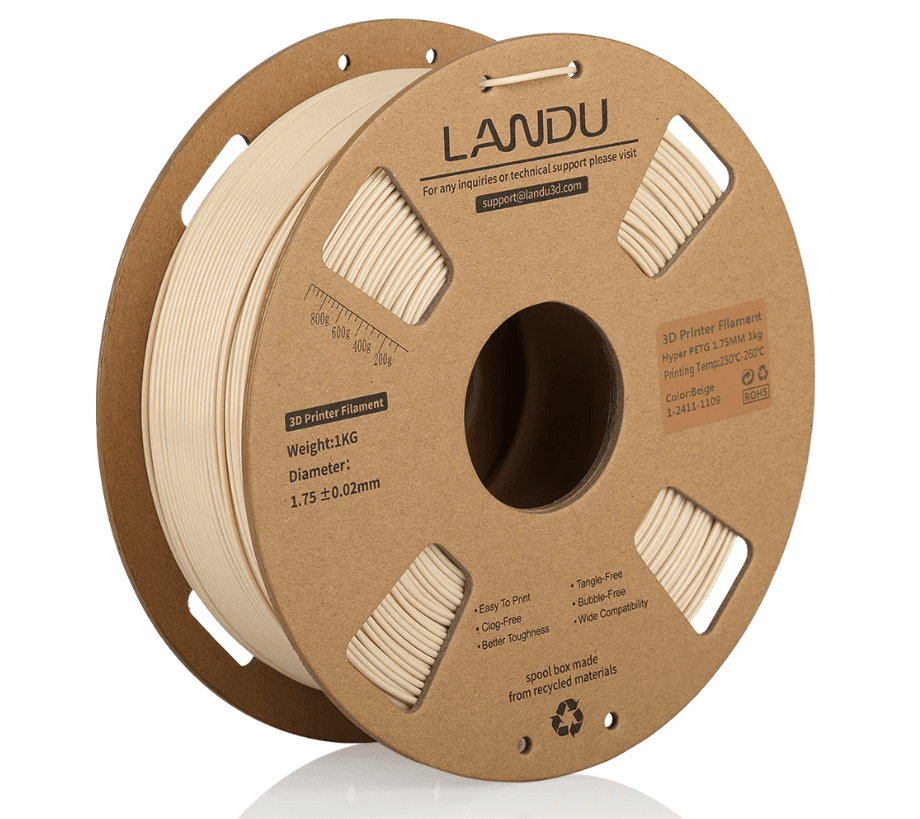
Landau PETG 1.75mm 1kg
Landau PETG 1.75mm 1kg — multiple colours, vacuum-sealed, fast UK delivery.
From £7.00 – £7.70
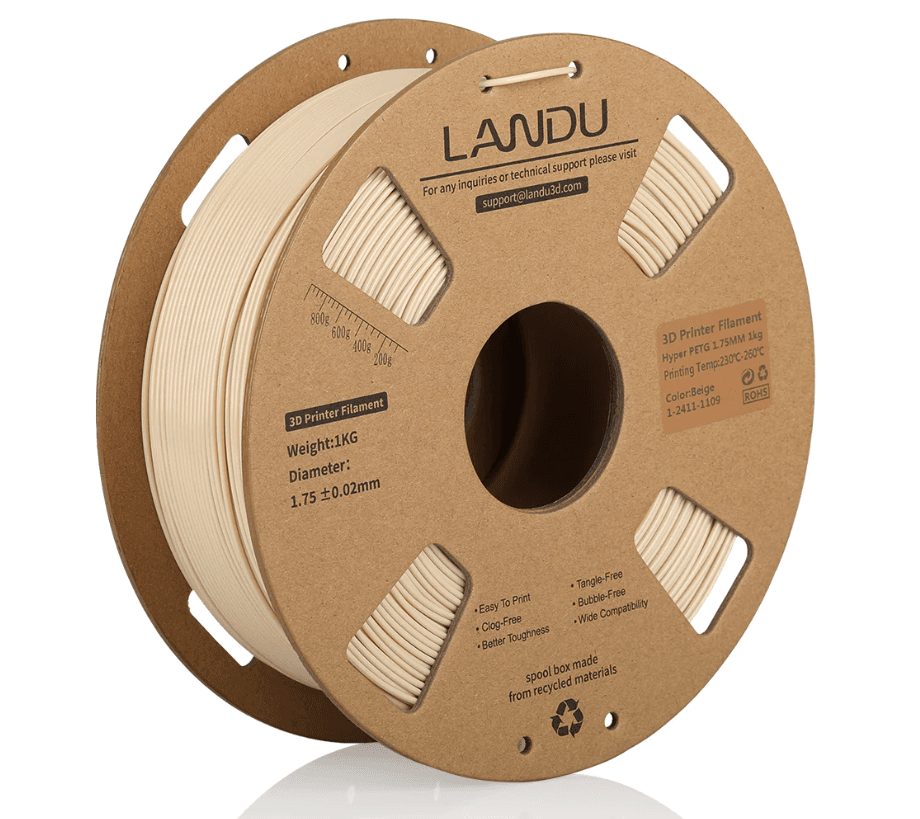 Out of stock
Landau PETG Pro 1.75mm 1kg
Landau PETG Pro 1.75mm 1kg — premium 3D printer filament.
From £9.25
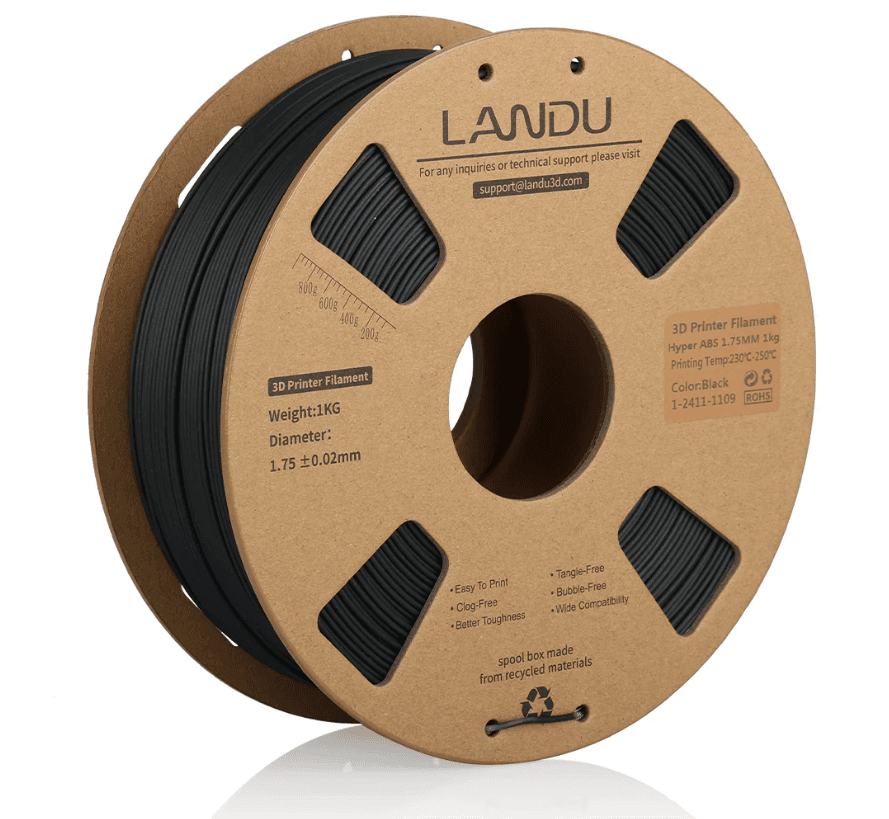
Landau Hyper PETG 1.75mm 1kg
Hyper PETG 1.75mm — high-speed printing without sacrificing surface quality.
From £9.25
 Out of stock
Landau PETG Carbon Fibre 1.75mm 1kg
Landau PETG Carbon Fibre 1.75mm 1kg — premium 3D printer filament.
From £12.50
What PETG is for
PETG is the material for parts that have to do a job. Brackets, enclosures that live in a warm place, water-tight containers, clips that flex, and anything that will be dropped. It bends measurably before it fails, where PLA simply snaps.
It holds up to roughly 75–80 °C, which covers a car interior in summer and the inside of most electronics enclosures. It is also food-safe as a polymer, although a 3D-printed surface is not food-safe regardless of material because the layer lines harbour bacteria.
Layer adhesion is excellent, which is what makes it water-tight: a PETG print with sufficient walls will genuinely hold liquid where the same part in PLA weeps through the layer boundaries.
What PETG is bad at
Fine detail. PETG oozes more than PLA and rounds off sharp corners. For miniatures and anything where crisp detail is the point, PLA gives a better result.
Bridging and steep overhangs. Less cooling means less support from the air, so unsupported spans sag further than they would in PLA.
Being printed straight out of the bag after a month on the shelf. PETG absorbs moisture faster than PLA and wet PETG strings badly, pops audibly, and prints with a rough matte surface. This is the single most common cause of "my PETG is stringy".
Sticking too well. On a smooth PEI or glass bed, PETG can bond hard enough to pull chunks out of the surface. A thin layer of glue stick as a release agent is the standard fix — counter-intuitively, you use glue to make it stick less.
Choosing between our PETG ranges
Standard PETG covers most work and is the range to start with. PETG Pro has tighter diameter consistency and a cleaner surface finish, which shows on large flat faces.
Hyper PETG is tuned for high-speed machines in the same way Hyper PLA is — worth it on a printer that can actually use the flow rate, wasted on one that cannot.
PETG Carbon Fibre is significantly stiffer and prints with a handsome matte finish, but it needs a hardened nozzle and it is more brittle than plain PETG. Reach for it when stiffness matters more than impact resistance.
Getting a good result
Start at 240 °C and 75 °C bed. PETG is more sensitive to being too cold than too hot — under-extrusion and poor layer bonding usually mean go up, not down.
Drop cooling to 30–50%. Full cooling is the classic PETG mistake: it looks like better overhangs and produces weak, delaminating parts.
Dry the filament if it has been open more than a few weeks. Four to six hours at 65 °C. Most "bad PETG" is wet PETG.
Slow retraction down and reduce its distance compared with PLA. PETG is stringier by nature and aggressive retraction grinds it in the extruder rather than fixing the strings.