
Material
ABS filament — 1.75mm, 1kg spools
The engineering choice for heat and impact resistance. Demands an enclosure and ventilation, and rewards you with parts that survive things PLA cannot.
- Nozzle
- 240–260 °C
- Bed
- 95–110 °C
- Cooling
- Off, or minimal
- Enclosure
- Required in practice
- Drying
- Worthwhile
Starting values — adjust to your own printer and conditions.
ABS in stock
3 ranges shown
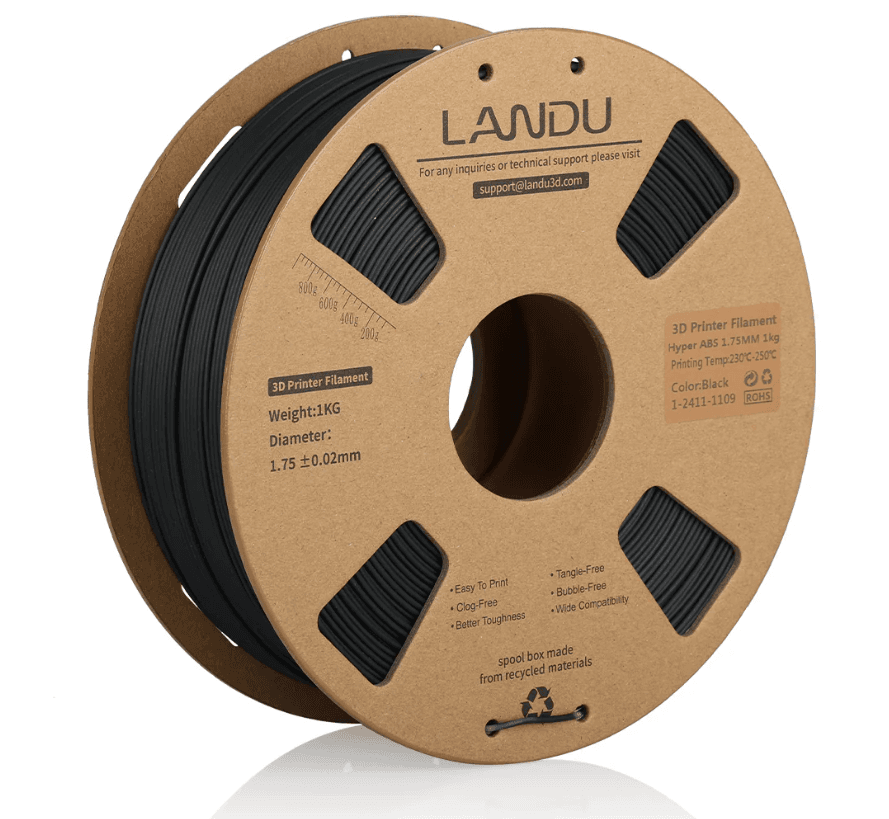
Landau ABS 1.75mm 1kg
Landau ABS 1.75mm 1kg — multiple colours, vacuum-sealed, fast UK delivery.
From £7.70 – £9.99
 Out of stock
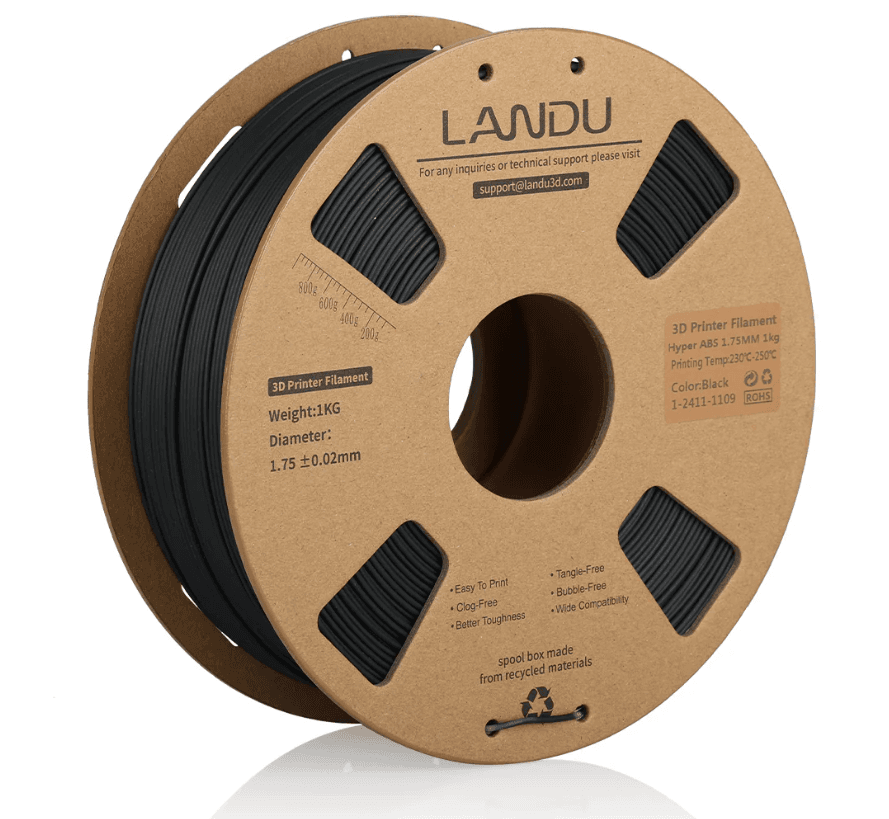
Landau Hyper ABS 1.75mm 1kg
Hyper ABS 1.75mm — high-speed printing without sacrificing surface quality.
From £9.25

Landau ABS Carbon Fibre 1.75mm 1kg
Landau ABS Carbon Fibre 1.75mm 1kg — premium 3D printer filament.
From £10.00
What ABS is for
ABS handles heat that would destroy PLA and softens around 100 °C, which puts it in a different category for anything mechanical, automotive or near a heat source. It is also genuinely tough: it absorbs impact by deforming rather than shattering.
It machines and finishes well. ABS can be drilled and tapped without cracking, and it can be vapour-smoothed with acetone to a glossy, effectively water-tight surface — a finishing route no other material here offers.
For functional prototypes that need to behave like injection-moulded parts, ABS is the closest match, because a great many injection-moulded parts are ABS.
What ABS is bad at
Warping. This is the defining difficulty. ABS shrinks measurably as it cools, and on an open printer the corners of a large part lift off the bed and the print fails. An enclosure that keeps ambient temperature up is not optional for anything larger than a few centimetres.
Ventilation. ABS emits styrene while printing, with a smell most people find unpleasant and which should not be breathed in a small unventilated room. Print it in a ventilated space or a filtered enclosure.
Sunlight. ABS yellows and becomes brittle under UV. For outdoor parts use ASA, which is chemically similar and UV-stable.
Fine surface detail on tall parts, where the lack of cooling shows.
Choosing between our ABS ranges
Standard ABS is the general-purpose option. Hyper ABS is formulated for higher print speeds and is somewhat easier to get a clean result from, because its flow behaviour is more consistent.
ABS Carbon Fibre is markedly stiffer and warps noticeably less than plain ABS — the fibres restrain the shrinkage — which makes it the easier ABS to print large parts in, at the cost of needing a hardened nozzle.
Getting a good result
Enclose the printer and let it warm up before starting. Ambient temperature matters more than any slicer setting for ABS.
Turn part cooling off, or run it under 20%. Cooling is what causes layers to contract at different rates and pull the part off the bed.
Use a brim. Even a five-line brim dramatically improves the odds on a large footprint.
Do not open the enclosure mid-print to look. The temperature drop is exactly what causes the delamination you were checking for.