
Material
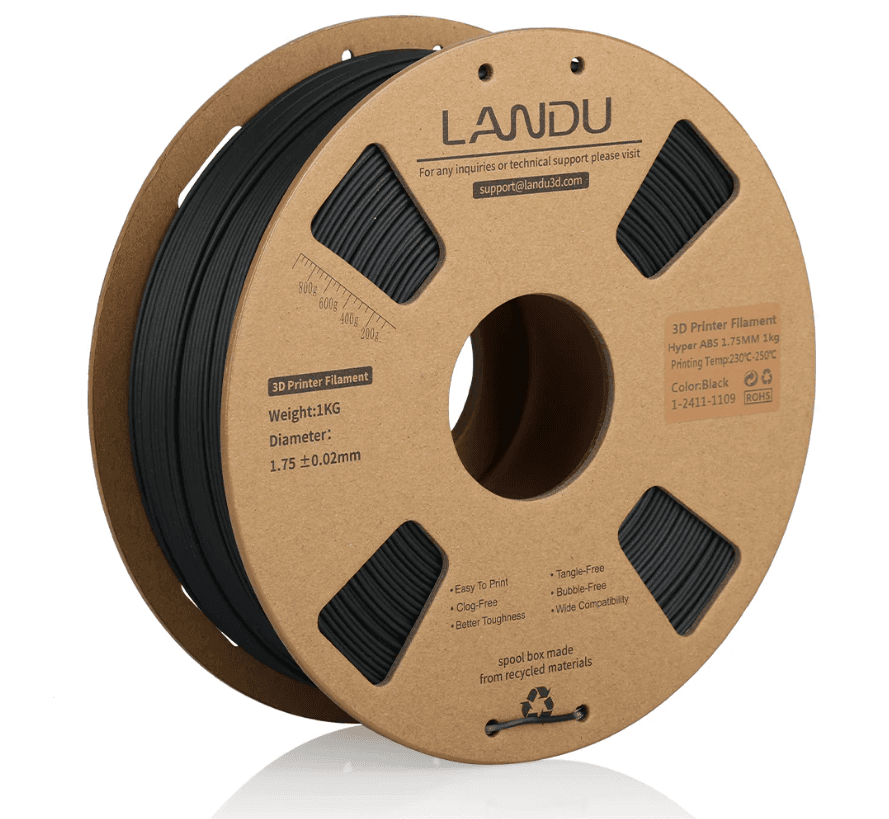
ASA filament — 1.75mm, 1kg spools
ABS that survives the weather. The right material for anything that lives outdoors, and the only one here that will not go chalky in sunlight.
- Nozzle
- 240–260 °C
- Bed
- 95–110 °C
- Cooling
- Off, or minimal
- Enclosure
- Required in practice
- Drying
- Worthwhile
Starting values — adjust to your own printer and conditions.
ASA in stock
What ASA is for
Outdoor parts. ASA was developed as a UV-stable replacement for ABS and it is the reason garden furniture, wing mirrors and signage survive years of sunlight without going chalky. If a printed part will spend its life outside, this is the material.
It shares ABS’s mechanical properties almost exactly: similar heat resistance, similar toughness, similar ability to be drilled and tapped. Think of it as ABS with the weakness removed and a small price premium added.
It also warps slightly less than ABS in practice, which makes it a little easier to print large parts in despite the near-identical settings.
What ASA is bad at
Everything ABS is bad at, minus the UV problem. It still warps, still needs an enclosure, still wants ventilation, and still gives poorer fine detail than PLA.
Price. ASA costs more than ABS, so using it for an indoor part is money spent on a property that part will never exercise.
Printing in a cold room. More than any other material here, ASA punishes a draughty workshop. If parts are lifting, the answer is almost always ambient temperature rather than a slicer setting.
ASA or ABS?
Outdoors, or exposed to strong sunlight through glass: ASA, without hesitation.
Indoors, in a cupboard, inside a machine: ABS, and keep the difference.
If you plan to acetone-smooth the part, both respond, though ABS is slightly more predictable.
Getting a good result
Treat it exactly as ABS: enclosure, no part cooling, brim on large footprints, and no opening the door mid-print.
Start at 250 °C nozzle and 100 °C bed and adjust in 5 °C steps.
Dry it if it has been open a while. Wet ASA prints with a rough, bubbled surface that no temperature change will fix.